Balance of payments

Written by: Umar Bostan
Updated on05 October 2026
What is the Balance of Payments?
The Balance of Payments (BoP) is a record of all financial transactions between a country and the rest of the world.
Money flowing into the country is recorded as a credit (+), while money flowing out is recorded as a debit (-).
There are three main components:
Current account
Financial account
Capital account
Current Account
The current account records international trade in goods and services, as well as flows of primary and secondary income.
Current account = net trade in goods and services + net primary income + net secondary income
For example In 2024, the UK recorded a persistent current account deficit of £63.2 billion (2.2% of GDP).
Trade in Goods and Services
This records the value of exports minus imports.
If exports exceed imports, there is a trade surplus. If imports exceed exports, there is a trade deficit.
For example The UK’s £210.7 billion trade-in-goods deficit (7.3% of GDP) was largely offset by a £185.5 billion trade-in-services surplus (6.4% of GDP) in 2024 .
Net Primary Income
Net primary income includes income flowing between countries from:
Profits
Interest
Rent
For example, profits earned by a UK owned company abroad would create an inflow into the UK current account.
Net Secondary Income
Net secondary income includes transfers where no good or service is directly exchanged, such as:
Remittances
Foreign aid
Gifts
Pensions
Financial Account
The financial account records flows associated with changes in ownership of financial assets and liabilities between countries.
It includes:
Foreign Direct Investment (FDI) – investment in productive assets such as factories or businesses.
Capital Account
The capital account is relatively small and records capital transfers.
Why Does the Balance of Payments Balance?
In theory, the current account and the capital and financial accounts should offset each other.
Current account deficit = capital/financial account surplus
If a country spends more on imports than it earns from exports, this needs to be financed by money flowing into the country, such as foreign investment or the sale of domestic assets.
This is a major cause of concern for the UK Economy as the UK’s persistent deficit (£63.2bn in 2024) means relying on foreign money, helping overseas investors accumulate £2.1tn of UK assets. For example Foreign companies own 80%+ of Thames Water, 100% of Heathrow Airport . (ONS)
Current Account Deficit
A current account deficit occurs when outflows from the current account exceed inflows.
The UK has run a persistent current account deficit in every single year since 1984, averaging roughly 3% of GDP annually since 2000 , peaking at a record 5.5% of GDP (£100+ billion) in 2016 .
Causes of a Current Account Deficit
Higher Domestic Economic Growth
Rapid economic growth increases household incomes increasing demand for imports thus worsening the current account deficit .
UK household demand for imports is highly income elastic (elasticity around 1.5), meaning a 1% rise in UK GDP drives an estimated 1.5% surge in import volume
Appreciation of the Currency
An appreciation makes exports more expensive to foreign consumers and imports cheaper for domestic consumers.
Remember SPICEE: Strong Pound Imports Cheaper, Exports Expensive .
For example, following the pound's 15% appreciation peak in mid 2021, the UK trade deficit widened significantly .
High Relative Inflation
If UK inflation is higher than inflation in competitor countries, UK goods become relatively more expensive.
Relative inflation ↑ → UK price competitiveness ↓ → export demand ↓ + import demand ↑ → current account worsens
In 2022 UK inflation peaked at a 40 year high of 11.1% significantly outstripping G7 peers like the US (9.1%) severely eroding UK price competitiveness and causing the goods deficit to hit a near record £228 billion.
Low Relative Productivity
Lower productivity means firms produce less output from a given quantity of inputs, increasing unit labour costs.
Relative productivity ↓ → unit costs ↑ → export prices ↑ → international competitiveness ↓ → exports ↓ → current account worsens
For example UK output per hour worked has trailed the G7 average by approximately 15% for over a decade .
Poor Quality and Design
International competitiveness is not only determined by price.
Relative quality/design ↓ → foreign consumers switch to substitutes → exports ↓ → current account worsens
Domestic consumers may also prefer higher quality foreign products for example Prada handbags from Italy , increasing imports further.
Causes of a Current Account Surplus
The causes of a current account surplus are broadly the opposite:
Lower relative inflation
Higher relative productivity
Depreciation of the currency
Strong non price competitiveness
Lower domestic demand for imports
Strong overseas demand for exports
Policies to Reduce a Current Account Deficit
There are three main approaches:
Expenditure switching policies – switch demand from imports towards domestically produced goods.
Expenditure reducing policies – reduce spending in the economy and therefore spending on imports.
Supply-side policies – improve the competitiveness of domestic firms.
Expenditure Switching Policies
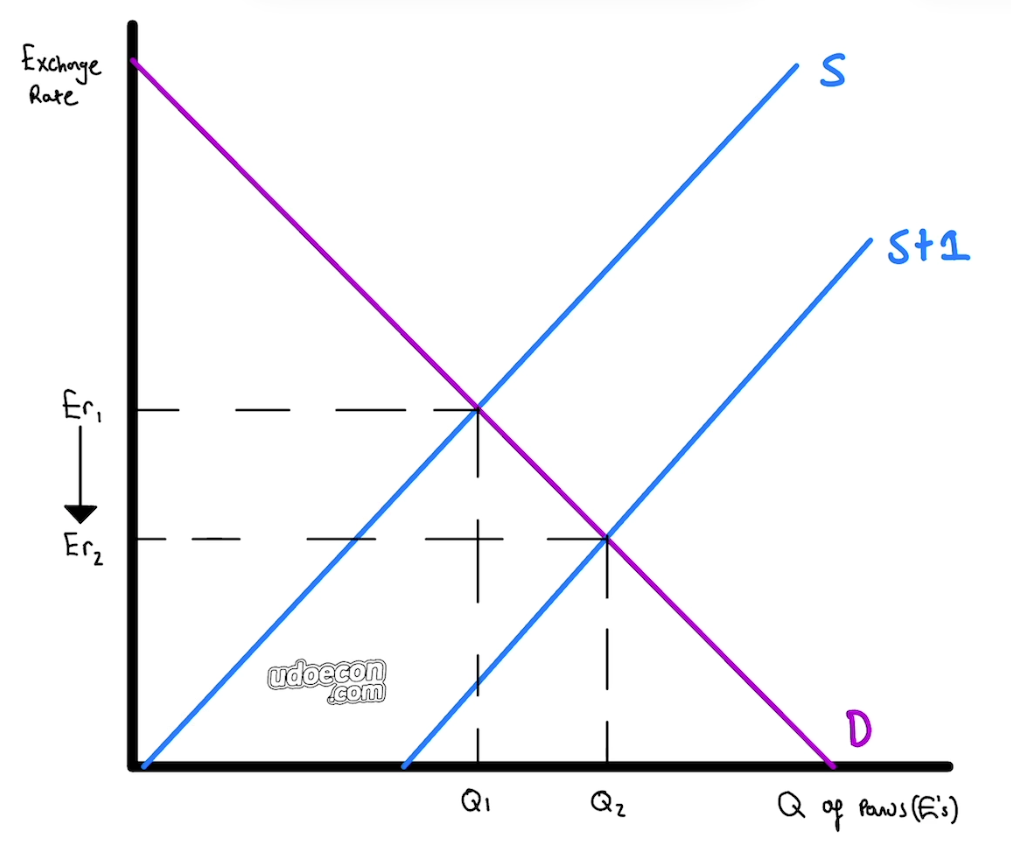
Low Interest Rates and Currency Depreciation
Low interest rates can act as an expenditure reducing policy by causing the currency to depreciate by encouraging hot money outflows.
Interest rates ↓ → returns on UK savings/assets ↓ → foreign investors move money abroad to seek higher returns → hot money outflows ↑ → supply of £ on the foreign exchange market ↑ → £ depreciates→ UK exports become cheaper abroad + imports become more expensive → export demand ↑ + import demand ↓ → net exports ↑ → current account improves.
Protectionism
Tariff ↑ → import prices ↑ → import demand ↓ → expenditure switches towards domestic goods → imports ↓ → current account deficit ↓
On the tariff diagram, the tariff reduces imports from Q1 − Q4 to Q2 − Q3 and consumers instead substitute buying domestically produced goods this switches expenditure from foreign firms to domestic firms thus improving the current account.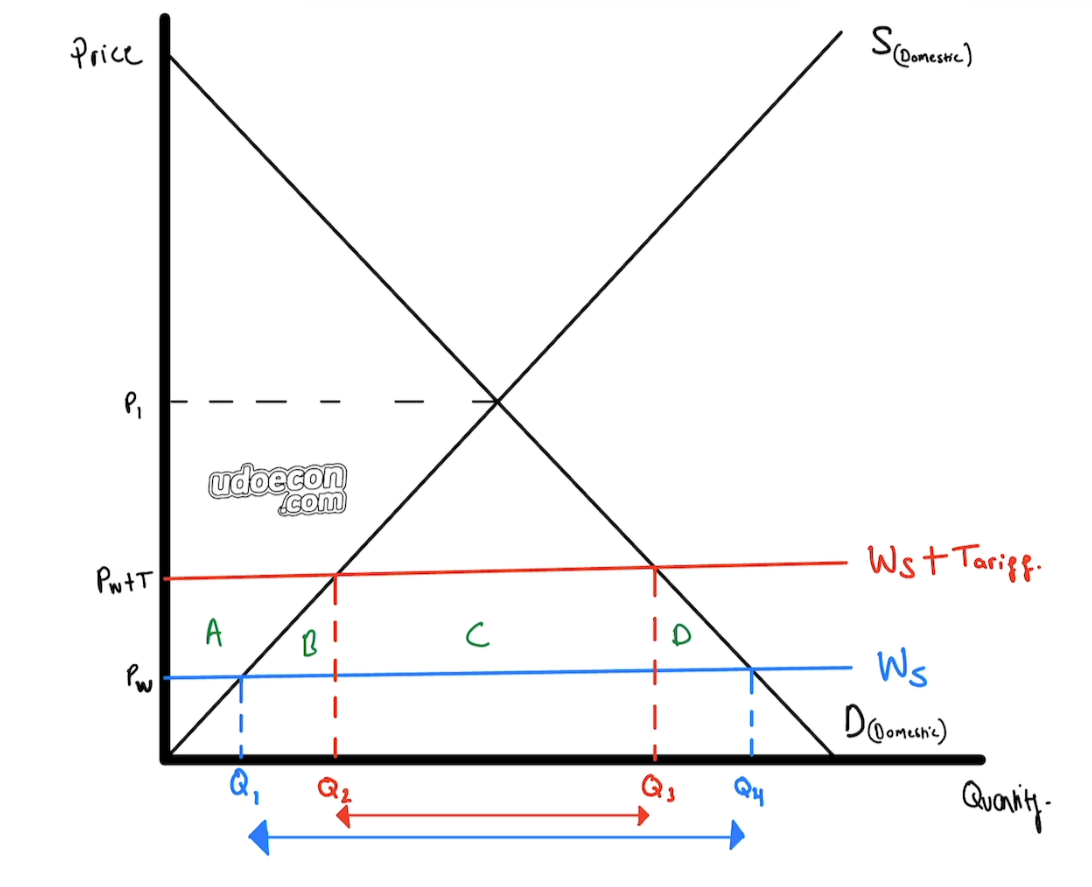
Expenditure Reducing Policies
Contractionary Fiscal Policy
The government could increase taxes or reduce government spending meaning consumers have less disposable income therefore cannot afford to spend as much thus reducing imports.
Taxes ↑ / government spending ↓ → AD ↓ → incomes and consumption ↓ → demand for imports ↓ → current account improves
Supply Side Policies
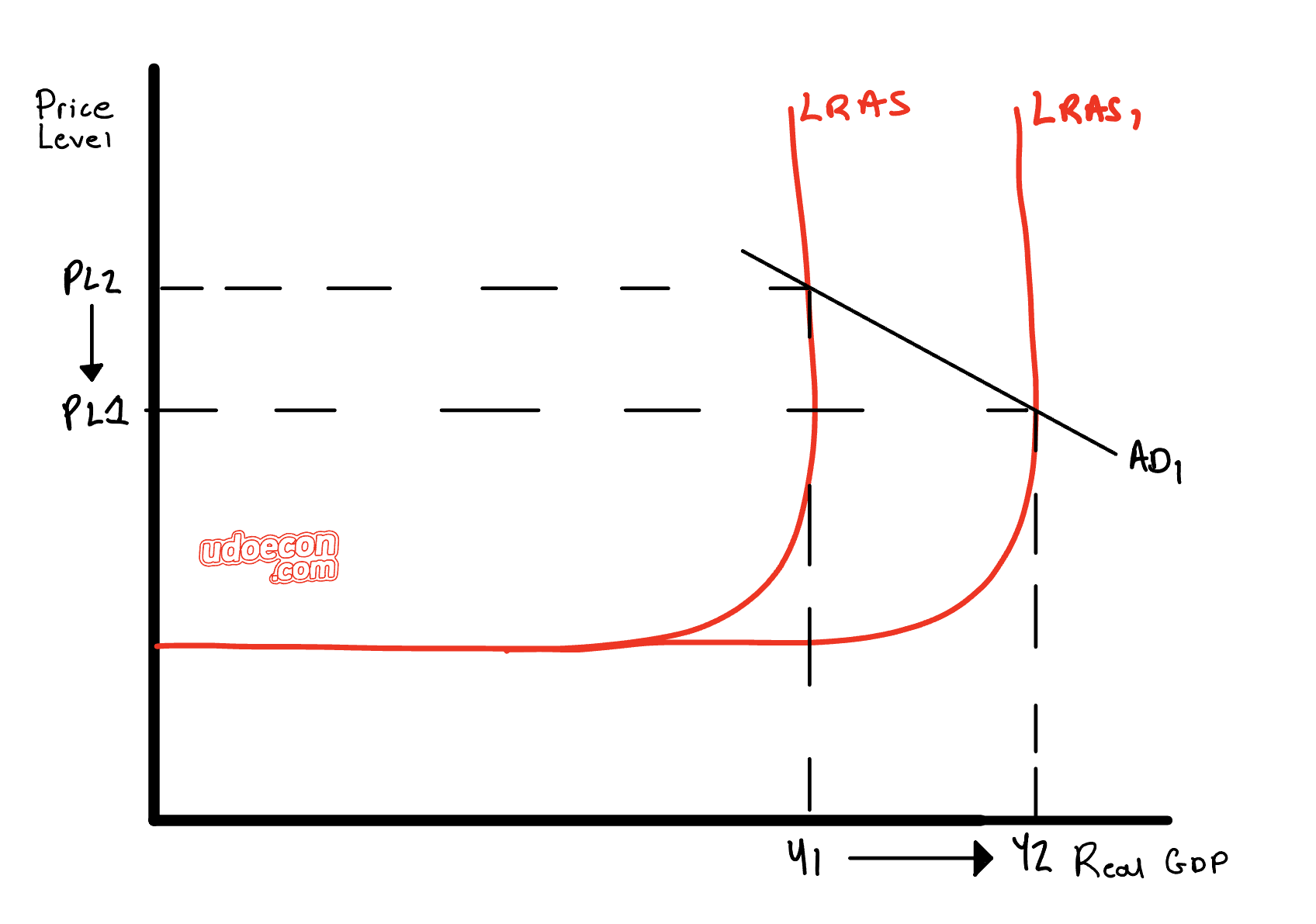
Supply side policies can improve productivity and the quality of domestic products.
Examples include:
Education and training e.g UK’s Growth and Skills Levy fund .
Infrastructure investment e.g HS2
Supply-side policies → productivity ↑ → unit costs ↓ → international competitiveness ↑ → exports ↑ → UK g/s are better quality/more competitive thus less need to import ↓ → current account improves
Self-Correction of a Current Account Deficit
With a floating exchange rate, a current account deficit may partly correct itself.
Imports ↑ + exports ↓ → demand for £ ↓ → £ depreciates → exports cheaper + imports dearer → exports ↑ + imports ↓ → current account deficit falls
Consequences of a Current Account Deficit
Overreliance on Imports
High imports can make an economy dependent on foreign countries for necessities . For example Following the Russia Ukraine war , UK gas prices surged to record highs with it spiking by 54% in april 2022 .
Increased Foreign Ownership
A current account deficit is generally associated with a financial account surplus.
Current account deficit → financial inflows required → foreign investment ↑ → foreign ownership of domestic assets ↑
This can mean future profits, rent and interest generated by these assets flow abroad rather than remaining in the domestic economy.
Is a Current Account Deficit Always Bad?
No. A deficit driven by rapid growth and funded by FDI builds LRAS, whereas a structural deficit caused by weak domestic productivity creates dangerous external borrowing dependencies.
Is the UK's Deficit Bad?
Yes, overall. The UK runs a persistent structural deficit (averaging 2.4% of GDP (£74bn) in 2025) driven by a deep annual goods deficit of £221bn that its £203bn services surplus fails to cover. Lacking strong manufacturing, the UK relies on short term portfolio capital inflows rather than long term FDI, leaving the economy reliant on "the kindness of strangers" and vulnerable .
Consequences of a Current Account Surplus
For example Germany recorded a massive current account surplus of €203 billion (4.5% of GDP) in 2025, driven primarily by its strong net exports in high value capital goods.
Net exports ↑ → AD ↑ → real GDP ↑ → employment ↑
Teacher Information

Specification 4.1.7
Past paper questions on this topic
9 matched questions to practise alongside these notes.
- A-level Paper 2, June 2025, Q2(a) · 1 marks
With reference to the chart above, which one of the following is correct?
- A-level Paper 2, June 2025, Q2(b) · 4 marks
With reference to the chart on the previous page, explain one likely reason for the change in the UK current account deficit from 2016 to 2021.
- A-level Paper 2, June 2025, Q4(c) · 2 marks
Explain the likely impact of the change in China’s terms of trade from 2012 to 2020 on China’s current account. Assume that demand for China’s exports and imports is price elastic.
- A-level Paper 2, June 2024, Q7 · 25 marks
Evaluate macroeconomic policies that could be used to reduce a current account deficit. Refer to a country of your choice in your answer.
- A-level Paper 2, November 2021, Q3(b) · 4 marks
Explain the likely impact of the change in the exchange rate of the pound shown in the graph from 1st January 2018 to 1st January 2019 on the UK current account of the balance of payments.